Showing posts with label communication. Show all posts

24 October 2017

New Players in Megagames

My intention is to write up my experiences in playing with new players in megagames.

New players are a great asset to megagames. Without them the genre would stagnate. They bring fresh ideas and enthusiasm that has driven the recent global expansion of megagames.

But I do worry that new players have a lot to learn in what is often a very confusing and fast moving event. Experienced gamers are aware of this and we do try to take the time to assist. But... it is a fast moving and confusing event


Red Dawn

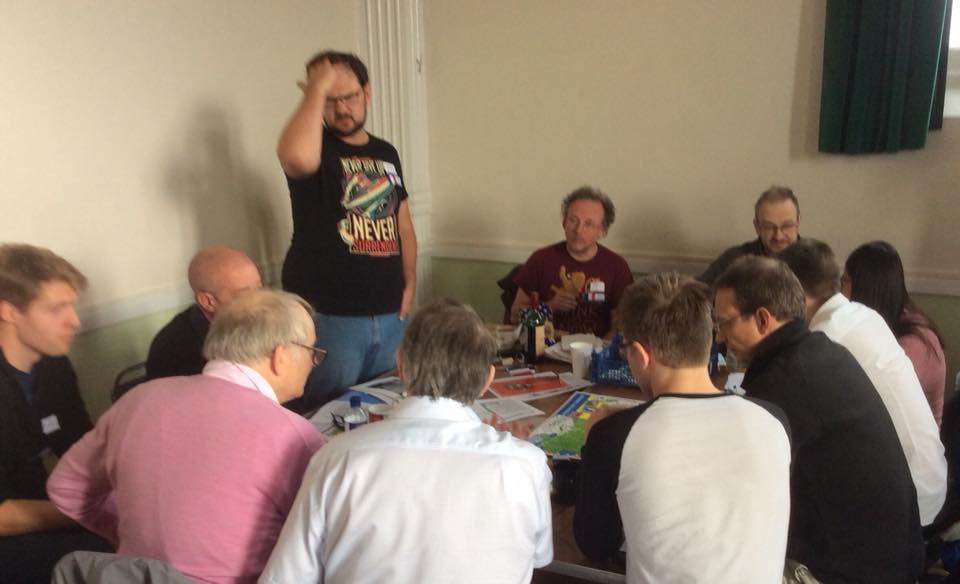
The Blue Interventionists-without-intervening team.
In the recent game I played in - Red Dawn - I was on a team that consisted of four players playing their first ever game, one player on their second game, three players who have played at least five megagames and two players who have played in too many games to mention in polite company, one of them being myself. The umpire was the most experienced of all of us.


Game Play and the inexperienced.

In Red Dawn - I was in a team of two, the Japanese Interventionists, attempting to defeat the Bolshevik menace and cooperate with my fellow Allies, the British, French and USA teams. 

In my team was Bob [not his real name] who was a new player to megagames. Bob made an excellent start. He had read the rules, and was able to find relevant passages on his tablet. We checked our understanding of the game aims and how we might achieve them. After that we quickly settled down into our roles, he as the operational player and I as the diplomatic player.  

During the game I mostly let Bob get on with his game. I noticed that after the initial chat he needed no guidance from me. For example: he quickly understood that though the diplomacy phase might take longer than it should, he should go to the map and get on with the next operational move when the phase had started.

There were a couple of issues I want to illustrate and discuss; issues that relate to Bob's inexperience with megagames.


1. Drag your feet

The arrival of the Japanese army units came at an opportune point for the Japanese. We were the last fresh and substantial force to be deployed. The theatre for our deployment was Siberia. There was no dispute or debate that the Japanese should be deployed to Siberia. All the other Allies had to support the move even though they knew the Japanese had their imperialist eyes on that part of the world. My comrade Allies made it plain that they expected the Japanese to clear all Reds from Siberia. So I agreed to this caveat to their support and ensured that Bob heard this too as I passed him his shiny new units.

Later on the next turn, I visited the Siberian map and checked in with Bob. He happily showed me his units had disembarked in Vladivostock and were moving to the front.  I told him we wanted to hang on to Vladivostock and its hinterland. So I wanted him to move only half his force to the hand-over point with the French Theatre Commander, and I wanted them to move slowly, not at best speed, to find reasons for being delayed, lack of trains, lack of railway staff, lack of food etc. I told him that I didn't want the Japanese to die for the Allied cause. I told him to drag his feet.

Up until then, I think Bob, had been happily playing his game, maximising his troops deployments, making his logistics work efficiently and generally being a good operational commander. And there was I telling him to go slowly, only commit half his forces and not be an effective commander. In other words, think of his side's real aims and ambitions. And remember the dictum: War is the continuation of politics by other means. This is why I like megagames so much. Players new to megagames might have heard of this dictum, but they'd never really understood it. Not until they played a megagame. I remember learning it myself in my early megagames. I hope new players learn this lesson too.


2. How're you doin'?

About two turns later I visited the map again, and this time had a chat with the Whites, the Cossacks and the Reds - yes I know, I talked to the enemy! I kept the chat straightforward and jolly, a bit of banter really, "how's it going", "your forces look a but done in", "now's the chance to swap sides" etc. But of course, I was really gathering Intelligence.
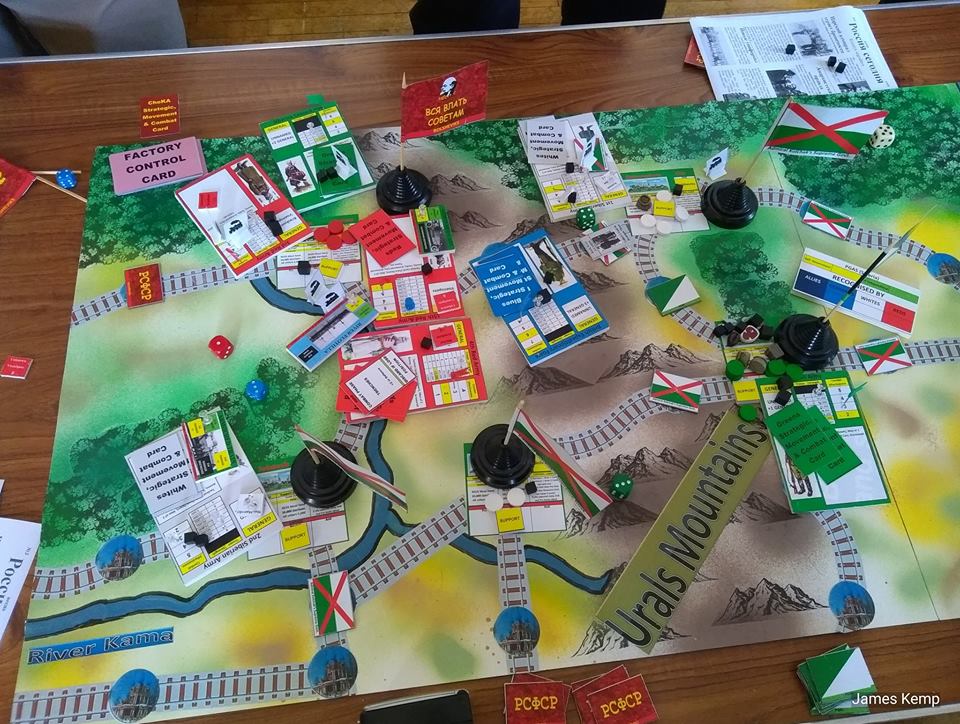

The small corner of Siberia that would
keep the Red Flag flying here
The Reds told me that they were relieved to still be on the map and that their game aim was to keep the red flag flying in the last corner of Siberia. They sounded confident. I also noted they did not refer to the next map and how they might be receiving reinforcements. My chat with the Whites involved references to alcohol, loot and their confidence in reaching Moscow. In other words the usual White bluster and lack of real direction. In my chat with the Siberian Cossacks, I was told that they were going to win, but it would take a few more turns, and they were confident this. As I was leaving they mentioned that they could do with some more food and ammo, just to be sure they would win! I said I would see what I could do.

I checked the next map, which was Russia west of the Urals, and noticed stacks and stacks of Red armies recruiting, reorganising and no doubt being fed into other Theatres, including Siberia.

My assessment was that even if I committed the Japanese forces whole-heartedly we were just going to get chewed up. The Red menace had been contained at best but looked united and centralised as opposed to the disparate groupings of Whites, Greens, and Blues fighting them. The fighting should be left to the locals with logistical support from us. Any further involvement of my forces might mean I would not get to seize Siberia and Vladivostock in any strength.

I checked with Bob about his view of the map and he didn't really seem to have a picture like I had. He told me about the deployment of our units and what he had seen of the fighting, but not what was in the minds of the commanders. I told him what I had found out from chatting to the players and asked if he could afford to spare some supplies for the Cossacks. We had earlier promoted their self-rule and got it recognised by the Allies. I had judged them too difficult to fight and they would form a useful pool of mercenaries and guard dogs for later Japanese Imperial expansion in the area. Getting them on-side, supplying them, whilst getting them to do the dying, meant they would owe me a favour and weaken themselves too.

The lesson here is to talk to the players. New players might be nervous talking to new players, they might be unsure of the etiquette, and not sure of the game mechanic. I was confident that in an open map game with turns a season long, my character would be able to receive and digest a lot of intelligence reports and attend a lot of cocktail parties that would give them a good picture of what was on the ground and in the mind of the opposition. The game would've been designed differently if this was not possible. 

Megagames are mostly conversational games with a few mechanics that pin down some of the game facts. 

Learning to talk to other players is an essential part of playing megagames, even for operational / map based players, though to a lesser extent than the politicos.


Conclusion

My conclusion is that megagames have been for me a great learning experience. I have learnt lessons about the complex nature of operational warfare, the never absent influence of politics and how to work and cope with a stressful human activity that involves more than a half-dozen people. 

Some would suggest that megagames only teach you how to play megagames; and they have a point. Games are not simulations or models, they are games. But I like to think my megagaming experience has enhanced my understanding of history and my experience of working in a team.

Perhaps this goes someway to tackle the allegation that some players make that megagames should have more structure, less ambiguity, more precision in handling rules interpretations and Control adjudications. My suggestion is that megagames are not about giving you a structured gaming experience; sometimes you will experience inconsistencies. This might spoil your game if your world-view is that games should not do this. The golden circle of the gaming experience can be a place to experience consistency and adherence to rules. Which is all the more apparent because the world is not like this.

And this is my point. I hope that players new to megagames gain a playing experience that enhances their appreciation of the real world of politics and warfare, in the contemporary world and in history. And have some fun along the way.

23 March 2015

The cracks between tables: Moving the narrative between teams in megagames

I have another confession to make as an Control Umpire for Megagames.

This is similar to the Rubber Failure I wrote about earlier. This time I want to talk about a failure, why it happened, why Megagames are more prone to this particular problem and how it could be solved and the problems with the solutions.


The fail

In the Megagame Watch The Skies 2 (WTS2), there was a problem of an asteroid that was predicted to be about to hit earth with the potential for ending all life on the planet.

I was the Control Umpire for the Alien Expeditionary teams. One of my teams came to me and said they had heard about this asteroid from a human government and wanted to help by averting this disaster.

We talked the various solutions through - this was me as an umpire role-playing their various scientists and technicians on the players' staffs. The team decided which solution they wanted to do, they paid the cost and the asteroid was diverted onto a new course that would take it harmlessly past earth and into the sun. I charged them four Activation Points to do this. This was half the cost of creating a moon base for them. The cost was mostly in lost opportunities, as sending a light spaceship with the right kit onboard to land on the asteroid was a trivial problem for them. They just lost the ability to use the spaceship to do other useful stuff.

And this is where it got difficult and I think I failed as an umpire. I forgot to follow through on this outcome. I forgot to tell the players to tell whoever had told them about the asteroid that they had diverted it. And I didn't think to find the umpire who had deployed this problem and tell them (and I didn't know who the umpire was).

I think this is why later in the game we were told there was a second asteroid. The message about the solution had not got through to whoever generated and was driving the problem.


The problem of umpire to umpire communication

And I think this was the fail. A failure of an umpire to liaise with another umpire.

How else does my ruling get fed back to the umpire who owns the problem? Until the umpire owning the problem is informed the problem will remain, no matter what steps other players and umpires do in the game.

I have attempted to reconstruct lines of communications that led to this - or just guessed.

Rob, one of the game control umpires, who sits outside the team and map games, has a role to have an overview of the game, and to generate problems to prod parts of the game that need a stimulus. If he thinks Table A is quiet or Team 42 is not having a good game he can drop a little bombshell in their laps. This was part of his role. To do this he tells some players or umpires about an incident. My guess is that Rob told those teams that had advanced astronomy or organisations like NASA etc. So it would probably be the American, Russian, and Chinese teams. Again this is a guess.

I do know that the USA team discussed the Shakewell asteroid problem. At some point they asked their alien player "friends" to help and the aliens were willing to help the USA and said they would do it. This alien team worked out a solution with me, paid the resource cost and diverted the asteroid. And then I forgot to check that the solution would get passed down the chain of communication.
  • Did the aliens tell the USA they had solved the problem?
  • Did the correct player on the USA team hear about the solution?
  • Did that player then tell the correct umpire that it had been solved?
  • And why didn't I follow up and find the umpire and liaise with him?

The cracks between the tables are bigger than they look.

At the risk of sounding the obvious, this is the most difficult thing to do in multi-player, multi-room or multi-table games. How to move information between tables is hard. Sometimes it is obvious. For example, when a spaceship blew up over Italy, I told the Europe Regional Map Control Umpires about this and let them run with it. But it was upto me as an umpire to liaise with other umpires about this big news.

But when my aliens divert an asteroid into the sun, who do I tell? The players were two steps away from the umpire who generated it. So they cannot tell me which umpire I need to liaise with.

I should have found out. I should have guessed. My bad.

Solutions

I can think of two solutions.

1. Don't worry about it - it's just a narrative. The game is actually a narrative that is being told by the players with assistance from the umpires. So there is not a "game reality" and I did not fail. We are just adjusting our narrative as best we can communicate. Only when the story is told and accepted does the story appear in the game reality.

Though I have conceptual problems about this. I do perceive there is a "game reality" which has consequences for actions. So we have to get it right.

2. Have concrete things to represent real world problems. For example the Umpire generating or handling a real world problems outside of the main rule set, hands out cards - pre-prepared - with his details on it - from the desk of  the umpire for game control. These cards are handed out as the problem is introduced and the players are told that these need to be shown to the umpires or other players. When the card is resolved, the umpire or player can take it back to the original umpire.

The problem with this is having enough cards, of players hanging onto cards and not handing them on, or just loosing cards.

Another issue is that it limits the creativity of the umpires, having to think up of problems pre-game to print out.


Discusson

I hope this little admission is taken in the spirit it is given. 

I am trying to improve the experience of megagames and trying to learn lessons so that others might learn too. 


22 March 2015

Confessions of a Civilized Umpire

I had an interesting and challenging role as one of the Control Umpires for the Alien teams in the megagame Watch the Skies 2.

I had enjoyable game, though one now served with a cold slice of guilt.

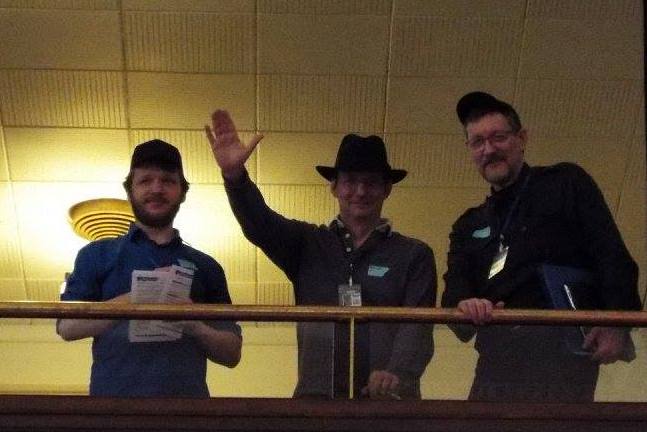
Half of the Alien Control Umpire Team, in their
balcony backwater. (L-R Jaap, Nick and Jon.)
After the game I had a post-game chat with Simon and Jerry, control umpires for the science game, and Paul, one of the African regional map control umpires. They had grinding games, with little respite, and little chance to get involved with the players other than driving the game at busy tables.

Also Paul asked me where the Alien Control team were, because we did not get down to the Regional Map Tables to liaise with them and collect and deliver messages.

So, I feel a little guilty that I had such a good game. And also I need to apologize to all the other Regional Map Control Umpires for our lack of liaising. Sorry guys.

So why was my game so different? In a nutshell I had a variety of thing things to do; some were even rules related, but most involved me using my judgement and what social skills I have.


Mentoring

The first duty of Megagame Control Umpires is to ensure that the players get a good game experience. Period! OK, we try to make consistent adjudications based on written rules, but we are really there to make sure that the players get a win from the experience.

And in WTS2 all the Umpires were very aware that we had many first time players. I think all the Alien players were first time players. That is a very high ratio. Most Megagames over the last few years have a cadre of returning veterans. These players are often cast as team leaders etc. and help initiate newbies through the rites of playing in a Megagame.

So during the setup and during the first turn I went from team to team and asked them if they had everything they required, if they had any questions, and could I help.

One team admitted they were very confused. So I told them that the start of megagames are usually like this though some of their problem were down to the fact that they were actually strangers in a strange land. I advised them to concentrate on scouting, intelligence gathering and even liaising with their "rival" teams. I also reminded them that all their actions had to be paid for in Activation Points (APs) and that they had a limited supply and a limited launch capacity. This started them off and after that they quickly learnt the ropes.

I was pleased to note that at the end of the game one of the players I had attempted to mentor did come up to me to thank me for helping him and his team out, and that he had had a great experience. Ahh... that pleases the twisted soul of an old grognard: enthusiastic young padawans.


Rules problems

After the first few turns the players settled in their roles, and had learnt the routine of each turn, and we left the to run their own internal games. This might be surprising to some people, but as Control we do not really see our role to check on the players. We just ask if they have any problems, we sort out problems and the game generally starts to run itself.

But there are problems. Most of the problems you have are those little pieces of grit that get swept up into the wheels of the game machine. For example during WTS2 players asked me the following questions:
  • The East Asian Regional Table Umpires did not give the alien players any "Human Specimen" cards after they had successfully played an abduction card? Was this correct?
  • I have just got a telepathy helmet. How can I use it to talk to Aliens?
  • How can I return this Cardinal to the planet in a shuttle and not get shot down?
  • How can we divert an asteroid's trajectory? One is about to hit Solaris C.

And this is why I like being an umpire. To resolve the above questions the Control Umpire has to role-play being a senior member of a player's staff, a civil servant, diplomat, scientist or military officer. The guidance for Control Umpires are explicit in this. The trick is not to give the solution, but to answer the questions put to you with a range of options, and to explain the risks, the advantages and disadvantages.


Lack of gaming materials

Some problems are more systemic. For example we had to guide the players through the rules for researching language and humanity. The rules were easily explained, but there was no game board to track the progress of such research. Now I think about it we should have drawn a track for them and plotted this. As it was on the day we asked the science players to come to the Umpires with their APs, and the requisite cards and keep their own track.

Another problem we had was that we ran out of models for PACs, and Shuttles and had to issue chits!


And then you have to make exciting decisions under pressure

The most challenging decision I had to make during the day was the proposed planetary bombardment by The New Republic (NR) team.

My main consideration was that I had to get this right as it was going to be a game changing action. Uptil then the aliens had abducted a few humans, but had not really done much damage. A planetary bombardment could destroy a large city and kill many millions of people.

The first thing I had to do was to remind them how this mission was done. A large capital spaceship enters into a low orbit and strafes the target. This might expose their ship to any space capable interceptors that humanity might have. It would definitely expose them to interception from other spaceships as the trajectory used to line up the strafe would be obvious to any nearby spaceships.

The problem I had as an umpire was that the tracking of fleets had been left to the High Politics game in the other room, which was on the opposite side of a large hall. I checked with Martin, the Control Umpire for the strategic space sub-game, what fleets were in the Solaris C solar system. I then made subtle inquiries with the High Politics teams about where their fleets were. I did not tell them why I was asking, and I asked about all of their fleets. I also asked them to give me the orders for each fleet. This took some time. Looking back on it it would have been great if there was a map with counters to track these things, but there wasn't and Martin and John were working hard to keep the game flowing for 15 players so they had not had the time to make one. Martin had tracked things with arrows on a map. But I wanted to hear from the High Command players what their orders were.

I was then able to tell the NR commander what ships might intervene if he carried on with his attack. This is information that would have easily been available to his staff, but the game system had caused the intelligence hard to find. The NR Commander had orders from his High Command to attack three locations: Rome, Rio de Janiero and Tokyo. I gave the NR player "on the ground" the information about the Imperial Fleet that could intervene. He made his deployment and was going to carry out his orders. I did give him an option to abort.

I then found the Imperial player "on the ground" and asked him some questions about his interstellar capability, what ships he had in the solar system, what bases he had and what was his posture. Again, general questions, but designed to get relevant information and not alert him to why I wanted to know.

I then warned both commanders that at the start of the next action phase I wanted them to report to me before they left for Solaris. Just winding them up really!

At the start of the next phase I gathered all the players round and brought the New Republican and Imperial Commanders to the front. I told all the players that there would be a delay in going down to the planet as we had an incident. I asked the Republican to repeat his orders. This was a nice bit of theatre. His orders were received with gasps, questions and cat calls from the assembled players. I clarified the dispositions of the Republican troops, writing them down on a piece of paper and gave a little explanation to the rest of the players about how the attack would be carried out. I then asked the Imperial player for his reaction and to be quick about it. He was quick and gave his deployment. I gave both players a last chance to avoid combat - this is almost always a possibility in space battles. Both would not stop.

The combat was quite simple, and I was ably assisted by Jon, another Umpire who had turned to right section of the rules and read out the results to each round of combat.

The outcome was that of the three straffing runs, the run on Rome was a draw, all craft on both sides were destroyed or seriously damaged, the attack on Rio ended in defeat of the Republican ship and the Tokyo run was unopposed. Tokyo was destroyed, killing about 10 million people.

This little battle was watched by all alien players (in the Solaris C solar system).

I then told Jim about the outcome of this action and went with him to the East Asia map and watched him implement the outcome. I had previously alerted Jim to the fact that one of the Alien teams were considering this attack, enabling me to get advice from him about the action and warning him of what was in the offing. I then went to the relevant maps - Americas and Europe - to tell the umpires that astronomers and some military installations would have noticed strange bursts of energy and explosions. And then some fragments would fall from space to the planet.


Player feedback

As usual with megagames we do not have a last turn, we merely announce towards the end of a one turn that this is the last turn. Game over. In a good game, the players are disappointed and want to enact their next turns plans, or to make that last rejoinder to the previous speech etc.

I was privileged enough in this game to be the umpire who announced the end of the game to two groups of players. All were disappointed and wanted to continue. One group, which consisted of the Senior Aliens and the UN Council (abducted earlier!) wanted their "last word" and kept on for a couple of minutes making their final points even though they knew the game was over.

That, I think, is a definition of an immersive and enjoyable game.

This makes Control Umpires around the world happy.


06 March 2015

Why I like playing megagames

I was recently describing a megagame to a non-game playing person.

Mike, was telling me how he had recently played a cooperative game with his niece and her family and had really enjoyed the experience. He added that in the past he had played the usual family fare of Monoploy, Cluedo and Risk, and has abiding memory of this was competitive bickering and arguing.

Mike went on to ask me about the games I play. Implying or assuming that they are competitive too, and how did I like or cope with this.

I tried to explain megagames, rather than other board games, though I did mention that I had played a few cooperative games like Pandemic, and had designed a cooperative game called Live and Let Live.

After my quick definition of megagames, as multiplayer games, with hierarchical teams reporting to each other, that often took up a historical scenario like WW2 or the Wars of the Roses, Mike than asked me if that is what I liked: trying to do better than history in the replay.

My answer: I play megagames because I get an understanding of how communications and negotiations work in a conflict and are perhaps the most important element. I might learn something about the history, and the background. But it is the experience of negotiating under pressure, the need to liaise, coordinate and work with my comrades and also with the umpires that makes these games so interesting to me.


17 February 2015

Where's my rubber? Moving information between tables in multi-table and multi-team games.

This might seem to be a very simple thing to do -- to move game related information between tables in multi-table and multi-team games -- but it ain't.

Getting it wrong

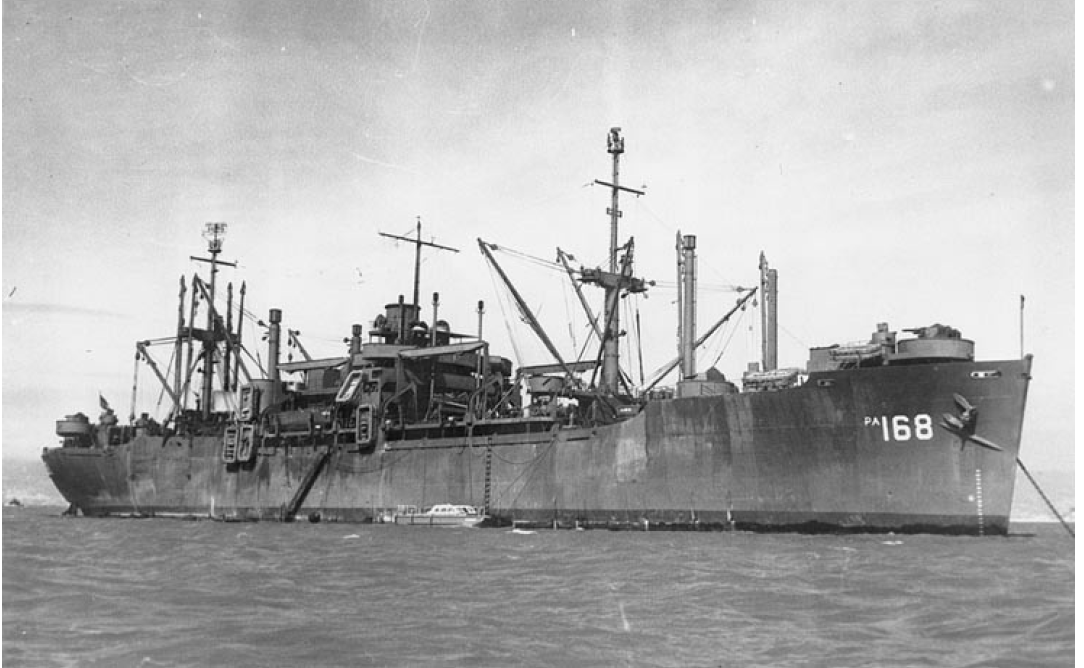
A Victory Ship - USS Gage
I can now admit that in one megagame I and another control umpire completely got this wrong for about 2 turns. We were running the western logistics board for the megagame the Last War, 1942 - 45. This mostly meant that we were running the Battle of the Atlantic. The rules were of course simple to adjudicate. However we did not know what to do with the delivered supplies.

Eventually our mistake contributed to the now infamous "rubber shortage scandal" of the game. With players saying "where's my rubber?", or "are you hoarding rubber?"

Here are the relevant rules:


  1. Check materials available via sea routes from naval Players. Note quantity shipped. This should be based on state of access at the END of previous turn.
  2. Check materials available by land routes on Land Map. Note quantity shipped. Collect Materials Counters from Control. This should be based on state of the routes at the END of last turn.
  3. Work out which Industrial Zones have their requisite materials by placing counters on the IC appropriate card.
  4. Hand over materials counters used this turn to Control.
  5. Collect output counters representing industrial output (Tanks/Man/Ships etc) from Control
  6. Distribute counters ‘manufactured’ to correct location on map (the location of the IZ) for use NEXT turn. 


Now I read it again, I can see why I was a little confused by this sequence. The goods shipped are in effect "manufactured" and should have been moved by someone in 6 - this was not spelt out.

The best way of smoothing these things out is to take the control team through the sequence in a test game and then for the control team to pass this knowledge on to their players during the game.

I still feel a little guilty about this. I know it effected the game as there was a big materials crisis that escalated upto the senior political players. When we realised the mistake we quickly recovered and we as control umpires went down to the relevant "land" table and delivered the goods at the end of turn.

Watch the Skies 2 - control team try out

The reason this has come to mind is that last night - 16 February - I participated in a megagame control team try out, and development session for the 300 player Watch the Skies 2 megagame. This was a very successful evening. Not only did we go through a couple of test turns, we also got to discuss rules changes and developments. This was great. It helped us all appreciate the turn sequences on the day that are sometimes implicit in the rules. For example, when the turn sequence calls for players to deploy their units, do they do this simultaneously or in sequence? These things can be spelt out in the rules, but often aren't and control have to resort to the old control motto of: if I don't know it is right, I can at least be consistent.

But the key thing for me was to establish what needed to be moved from table to table. These are the things that often go wrong. Watch the Skies 2 is going to be mostly a player led game, with the control team, monitoring, assisting and driving the game.

I will be one of the alien umpires. My players' tables will be kept away from the main "earth" tables. The Aliens are in effect in space or in orbits around earth. As each game turn will be about 3 months, the "human players" will be able to move about quite freely in comparison. What I wanted to establish was what will the Alien Players take to the table, get from the table and who will carry it.

I cannot go into too much detail, but it looks like this game's design has learnt from the earlier problems encountered in this tricky business of moving game information between tables in a multi-team game. From experience this is what can go horribly wrong in a megagame.

It's not just logistics

In the example I gave of the Last War and from our try out of Watch the Skies, I was most concerned about moving logistical resources between tables. The Aliens of course will have a resource allocation game too, and I will have this to monitor.

In some ways logistics are the obvious of inter-table bits of game information. But in the try out last night we had an example of how "intelligence" can be perhaps even more slippery as it moves between tables. I cannot go into detail at this stage. All I can say is that the Secret Agents deployed to the board can gather intelligence but the actual information they glean will be literally in the hands of another player or player team not located at the same table. I think we as control umpires have worked out a solution to this, but I know Jim and others did voice concerns that we are setting ourselves up for one of these inter-table movements of game information. Was the game effectiveness of this rule worth running the risk of failure?

I was interested to hear Jim say that one of his design concerns is to remove these inter-table hiccups by getting as much done on each table as was possible.

It might seem to be a small thing, but when you have 300 players and 45 control umpires and about 10 map tables things can easily go missing.


Popular posts