New players are a great asset to megagames. Without them the genre would stagnate. They bring fresh ideas and enthusiasm that has driven the recent global expansion of megagames.
But I do worry that new players have a lot to learn in what is often a very confusing and fast moving event. Experienced gamers are aware of this and we do try to take the time to assist. But... it is a fast moving and confusing event.
Red Dawn
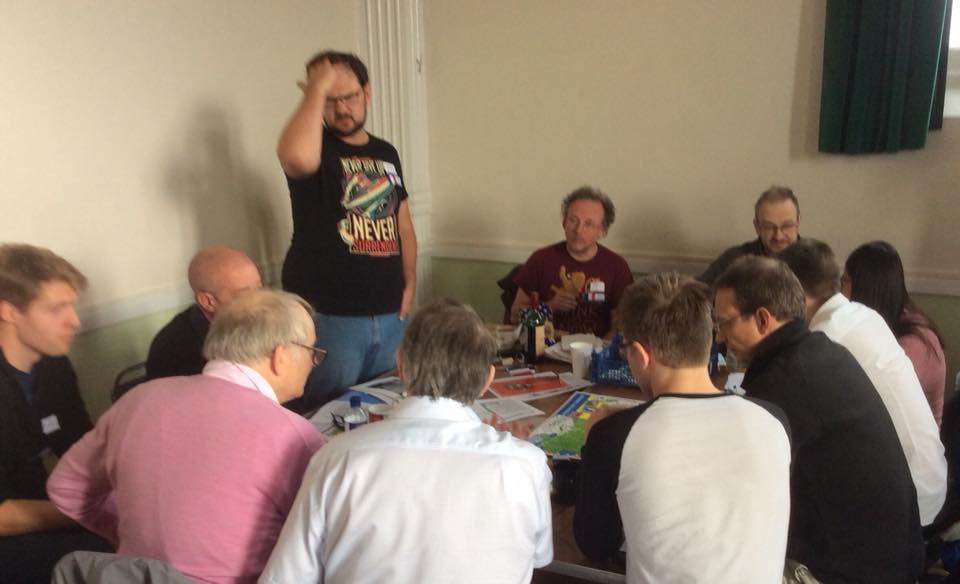 |
| The Blue Interventionists-without-intervening team. |
Game Play and the inexperienced.
In Red Dawn - I was in a team of two, the Japanese Interventionists, attempting to defeat the Bolshevik menace and cooperate with my fellow Allies, the British, French and USA teams.In my team was Bob [not his real name] who was a new player to megagames. Bob made an excellent start. He had read the rules, and was able to find relevant passages on his tablet. We checked our understanding of the game aims and how we might achieve them. After that we quickly settled down into our roles, he as the operational player and I as the diplomatic player.
During the game I mostly let Bob get on with his game. I noticed that after the initial chat he needed no guidance from me. For example: he quickly understood that though the diplomacy phase might take longer than it should, he should go to the map and get on with the next operational move when the phase had started.
There were a couple of issues I want to illustrate and discuss; issues that relate to Bob's inexperience with megagames.
1. Drag your feet
The arrival of the Japanese army units came at an opportune point for the Japanese. We were the last fresh and substantial force to be deployed. The theatre for our deployment was Siberia. There was no dispute or debate that the Japanese should be deployed to Siberia. All the other Allies had to support the move even though they knew the Japanese had their imperialist eyes on that part of the world. My comrade Allies made it plain that they expected the Japanese to clear all Reds from Siberia. So I agreed to this caveat to their support and ensured that Bob heard this too as I passed him his shiny new units.Later on the next turn, I visited the Siberian map and checked in with Bob. He happily showed me his units had disembarked in Vladivostock and were moving to the front. I told him we wanted to hang on to Vladivostock and its hinterland. So I wanted him to move only half his force to the hand-over point with the French Theatre Commander, and I wanted them to move slowly, not at best speed, to find reasons for being delayed, lack of trains, lack of railway staff, lack of food etc. I told him that I didn't want the Japanese to die for the Allied cause. I told him to drag his feet.
Up until then, I think Bob, had been happily playing his game, maximising his troops deployments, making his logistics work efficiently and generally being a good operational commander. And there was I telling him to go slowly, only commit half his forces and not be an effective commander. In other words, think of his side's real aims and ambitions. And remember the dictum: War is the continuation of politics by other means. This is why I like megagames so much. Players new to megagames might have heard of this dictum, but they'd never really understood it. Not until they played a megagame. I remember learning it myself in my early megagames. I hope new players learn this lesson too.
2. How're you doin'?
About two turns later I visited the map again, and this time had a chat with the Whites, the Cossacks and the Reds - yes I know, I talked to the enemy! I kept the chat straightforward and jolly, a bit of banter really, "how's it going", "your forces look a but done in", "now's the chance to swap sides" etc. But of course, I was really gathering Intelligence.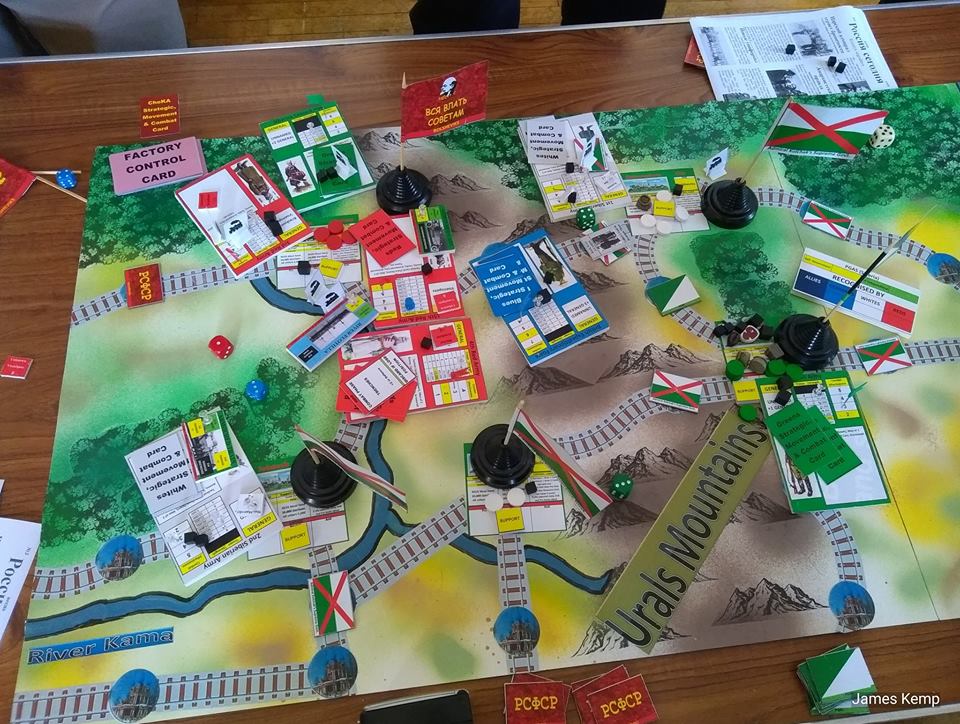 |
| The small corner of Siberia that would keep the Red Flag flying here |
I checked the next map, which was Russia west of the Urals, and noticed stacks and stacks of Red armies recruiting, reorganising and no doubt being fed into other Theatres, including Siberia.
My assessment was that even if I committed the Japanese forces whole-heartedly we were just going to get chewed up. The Red menace had been contained at best but looked united and centralised as opposed to the disparate groupings of Whites, Greens, and Blues fighting them. The fighting should be left to the locals with logistical support from us. Any further involvement of my forces might mean I would not get to seize Siberia and Vladivostock in any strength.
I checked with Bob about his view of the map and he didn't really seem to have a picture like I had. He told me about the deployment of our units and what he had seen of the fighting, but not what was in the minds of the commanders. I told him what I had found out from chatting to the players and asked if he could afford to spare some supplies for the Cossacks. We had earlier promoted their self-rule and got it recognised by the Allies. I had judged them too difficult to fight and they would form a useful pool of mercenaries and guard dogs for later Japanese Imperial expansion in the area. Getting them on-side, supplying them, whilst getting them to do the dying, meant they would owe me a favour and weaken themselves too.
The lesson here is to talk to the players. New players might be nervous talking to new players, they might be unsure of the etiquette, and not sure of the game mechanic. I was confident that in an open map game with turns a season long, my character would be able to receive and digest a lot of intelligence reports and attend a lot of cocktail parties that would give them a good picture of what was on the ground and in the mind of the opposition. The game would've been designed differently if this was not possible.
Megagames are mostly conversational games with a few mechanics that pin down some of the game facts.
Learning to talk to other players is an essential part of playing megagames, even for operational / map based players, though to a lesser extent than the politicos.
Conclusion
My conclusion is that megagames have been for me a great learning experience. I have learnt lessons about the complex nature of operational warfare, the never absent influence of politics and how to work and cope with a stressful human activity that involves more than a half-dozen people.
Some would suggest that megagames only teach you how to play megagames; and they have a point. Games are not simulations or models, they are games. But I like to think my megagaming experience has enhanced my understanding of history and my experience of working in a team.
Perhaps this goes someway to tackle the allegation that some players make that megagames should have more structure, less ambiguity, more precision in handling rules interpretations and Control adjudications. My suggestion is that megagames are not about giving you a structured gaming experience; sometimes you will experience inconsistencies. This might spoil your game if your world-view is that games should not do this. The golden circle of the gaming experience can be a place to experience consistency and adherence to rules. Which is all the more apparent because the world is not like this.
And this is my point. I hope that players new to megagames gain a playing experience that enhances their appreciation of the real world of politics and warfare, in the contemporary world and in history. And have some fun along the way.


